"Prism Net Worksheet: Learn with Fun Shapes"
Nets of prisms, a captivating topic in geometry and optics, offers a wealth of learning opportunities. These complex shapes, when interconnected, create intricate visual patterns that spark curiosity and intrigue learners of all ages. If you're a teacher or parent looking to engage students with hands-on, educational activities, look no further than a well-crafted nets of prisms worksheet.
Such a worksheet serves multiple purposes. It evaluates students' understanding of 3D shapes, their constituent surfaces, and the concept of nets – two-dimensional representations of three-dimensional objects. Plus, it fosters spatial awareness, critical thinking, and problem-solving skills. Let's delve into the world of nets of prisms, exploring key concepts, formulating effective worksheets, and understanding how they foster learning.
Understanding Nets of Prisms
Prisms are three-dimensional figures with parallel, congruent faces. A prism is composed of two congruent bases that are connected by rectangular faces or lateral faces. When we unfold a prism, we obtain a net – a two-dimensional representation of the three-dimensional shape. This net comprises the bases and lateral faces, which, when assembled, recreate the original prism.


Nets of prisms are versatile teaching tools. They can be used to explain the properties of prisms, explore the relationship between two-dimensional and three-dimensional shapes, and practice both visualization and construction skills.
Identifying Prisms and Their Nets
Understanding the difference between a prism and its net is crucial. A prism, as mentioned, is a three-dimensional shape with parallel, congruent faces. Its net, on the other hand, is a flat representation, consisting of rectangles for the lateral faces and congruent shapes (like triangles, squares, or hexagons) for the bases, attached by tabs.


In a nets of prisms worksheet, you might ask students to identify the prism represented by a given net. This can be done by evaluating the number of bases, the shape of the bases, and the number and size of lateral faces in the net.
Drawing Nets of Prisms
Drawing nets of prisms is an excellent way to evaluate students' grasp of the concept. Given a three-dimensional prism, students must visualize its two-dimensional representation. To do this, they first decide on the shape of the base and the number of lateral faces. Then, they imagine the prism unfolded, drawing the net on paper.
Worksheets can include exercises where students draw nets for given prisms, or vice versa – create prisms from provided nets. For instance, they might be asked to draw the net of a triangular prism with 5 lateral faces, or construct a hexagonal prism given its net.
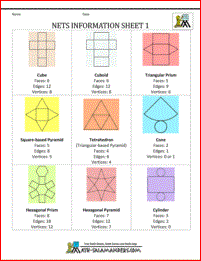


Creating an Effective Nets of Prisms worksheet
An effective nets of prisms worksheet incorporates a variety of question types, accommodating different learning styles and abilities. Here's a suggested structure:
1. Multiple Choice Questions: These assess understanding of basic concepts. For example, "What shape are the bases in a hexagonal prism?"
2. Identification Questions: Students identify the prism represented by a given net, or the net of a given prism.


3. Free-Response Questions: These engage students in drawing and construction. They might draw nets of prisms, build prisms from nets, or solve real-world problems involving prisms (like designing a fence or a bookcase).
4. Extension Tasks: These challenge advanced students. They might explore the interior angles of prism bases, investigate the volume and surface area of prisms, or compare prisms to other three-dimensional shapes like cones and pyramids.
Remember, the goal of a nets of prisms worksheet is not just to assess understanding, but to engage students in active learning. Make it interactive, involve practical tasks, and encourage students to ask questions and explore ideas.
In exploring nets of prisms, we've journeyed through understanding and identifying these complex shapes, drawing their nets, and creating effective worksheets. By incorporating such activities into your teaching, you're fostering a love for geometry and equipping students with valuable, hands-on learning experiences.
Related Articles

Free Prism Coloring Pages for Adults: Unwind with Geometric Vibes
Embarking on a journey into the captivating world of free coloring pages for adults, we can't overlook the mesmerizing impact of prism-themed pages. Prisms...

Mastering 3D Shapes: Drawing Perfect Nets Every Time
In the fascinating world of 3D modeling and rendering, creating intricate interconnected shapes is a common yet complex task. One innovative technique to...

Master Spanish Numbers in Colorful Printables: Learn Greetings & Goodbyes
Hola, amigos! Today, we're diving into the vibrant realm of Spanish numbers, colors, greetings, and goodbyes. Whether you're a beginner or brushing up your...

Dog Coloring Page: Learn Facts While You Color
Dog lovers, parents seeking fun activities for their kids, and educators looking for educational resources, you've come to the right place! Here, we present an...

Hebrew Letter Coloring Pages: Learn Chet with Fun Sheets
Discover the vibrant world of Chet Hebrew Letter Coloring Pages, an engaging and educational resource that combines fun with learning the Hebrew alphabet...

DNA Coloring: Engage & Learn with Fun Activities
The vibrant world of arts and crafts intersects with science in an engaging activity known as DNA coloring. This creative endeavor isn't just about adding hues...